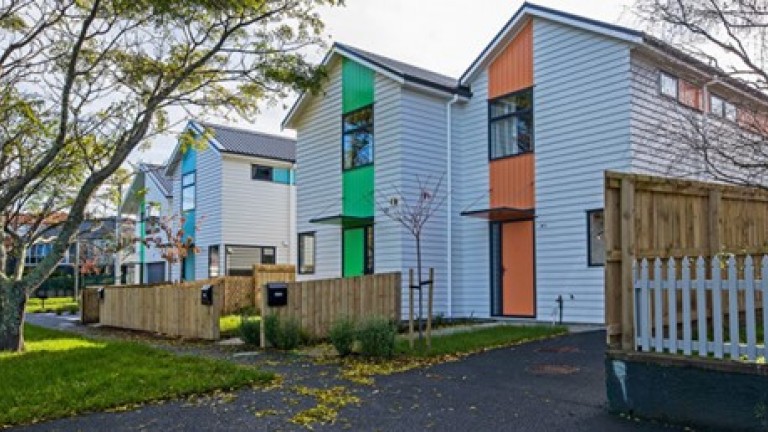
Sustainability montage image.

The Centre for Sustainable Cities is an inter-disciplinary research centre dedicated to providing the research base for innovative solutions to the economic, social, environmental and cultural development of our urban centres.

87% of New Zealanders live in cities.

The health and well-being of a significant proportion of our population is reliant on developing environments that take into account the connections between transport, design, energy, health and governance and other issues.

more info
News and Events: Browse by Category.

Low Impact Urban Development good for the wallet and environment

Strongly related to one of members, Landcare, on Low Impact Urban Development here’s a post by the
The Daily Score :

For years, environmentalists have touted “low-impact development” — letting soil and vegetation soak up heavy rains, rather than channeling storm runoff into gutters and sewers — as the best solution for stormwater. But as it turns out, LID has picked up a whole host of new fans: smart economists, developers, builders, and government regulators are now singing LID’s praises as well.

The fundamental principle of low-impact development is that it’s better — both for people’s pocketbooks and for streams — to prevent storm runoff than it is to treat it. That means building green roofs and rain gardens, installing rain barrels and cisterns, and using porous concrete and pavers. The conventional alternative is building an elaborate and expensive system of concrete storm sewers that funnel stormwater, as well as the trash and toxics it picks up, into streams, lakes, and bays.

And recent studies from around North America show that the principle has promise: real-world evidence shows that LID is, in fact, a cheaper way to handle stormwater, and it does so without the flooding risk or the damage to marine life, that the conventional approach to stormwater often carries with it.

Take, for example, this 2005 study by researchers from the University of Southern California and the University of California, Los Angeles. They point to a previous study, which had estimated that it would cost a whopping $284 billion, and require building 65 drinking-water treatment plants, to clean the filthy torrents streaming off of LA’s highways and rooftops. But the researchers concluded that LID, coupled with related strategies, could deal with stormwater in the sprawling metropolis at a cost of $3 billion to $7 billion — treating stormwater at pennies on the dollar, compared with the conventional approach.

Seattle Public Utilities has done some number crunching of its own. The utility found that using LID, or what they call “natural drainage systems,” to retrofit streets in need of stormwater treatment that the city spent $325,000 per block, compared to $425,000 if they had built traditional storm-drain-and-pipes infrastructure.

A good chunk of that savings likely came from the fact that the LID street has only one sidewalk (this is in a neighborhood that previously had no sidewalks) rather than two. But the comparison doesn’t count the many other benefits of LID, including improved property values (thanks to the improved aesthetics of the natural systems) plus the near elimination of runoff. That means no flooding and less dependence on combined-sewer overflows that can dump raw sewage along with stormwater into the sea and rivers (this talk outlines these additional benefits).

If you’re looking for good examples of smart LID projects, this EPA document is a stormwater solutions throw down. It concludes that, in 11 of the 12 projects studied, LID is the economic winner over conventional strategies. The savings ranged from 15 to 80 percent. Let’s take a look:

SEA Street Seattle: If you’re an LID fan, you already know about SEA Street, or 2nd Avenue Street Edge Alternative. This 2001 literally groundbreaking project was a rebuild of a residential street in which the road was narrowed, some sidewalks removed, and wide ditches called swales built along the pavement to catch runoff. The amount of impervious surfaces were reduced by 18 percent, and the redesign captures nearly all of the runoff according to studies tracking its performance. Plus, it’s really pretty with native plants and trees lining the street. It’s been replicated in neighborhoods around the city.

PROJECT COSTS

For a conventional retrofit: $868,803

LID retrofit: $651,548

Difference: $217,255 in savings

Parking lot retrofits, Bellingham: The city opted for rain gardens instead of underground vaults to capture and treat runoff from parking lots at city hall and Bloedel Donovan Park. Three of the city hall’s 60 parking spaces were converted into the rain garden. At the park, a 550 square-foot area was converted.

Rain gardens typically look like traditional landscaping, but can include planted depressions that are lined with layers of gravel and porous soil. Sometimes the depression can contain a drain that leads into traditional stormwater infrastructure to accommodate unusually heavy rains.

PROJECT COSTS

For vaults: $80,400

For rain gardens: $18,400
Difference: $62,400 in savings

Crown Street, Vancouver, BC: This 2005 retrofit of a Vancouver street was based on the SEA Street model. The project is expected to reduce runoff by 90 percent. The city opted for the LID design because the street reportedly drains into the last two salmon-bearing streams in Vancouver.

PROJECT COSTS

For a conventional retrofit: $364,000

LID retrofit: $707,000 (this includes $311,000 in consulting fees that would not be required for additional projects, making the cost $396,000)

Difference: $32,000, discounting consulting fees; however, according to the EPA report, the city estimates that the LID approach would be less expensive than a traditional stormwater system in areas of new development

Downspout disconnection program, Portland: Combined Sewer Overflows (CSOs) are a scourge of urban sewer-stormwater systems. In these systems, stormwater and sewage are mixed and treated in sewage facilities. In heavy storms, the treatment plants are overwhelmed by the extra runoff, and the combined waste gets dumped untreated into rivers and bays. And they’re really expensive to fix by separating the systems or increasing capacity.

So Portland is opting for a program that pays homeowners $53 for each downspout it disconnects from the stormwater system. Instead, the water flows into rain barrels or the home’s yard. More than 50,000 downspouts have been disconnected, channeling more than 1.2 billion gallons of water out of the CSO system.

PROJECT COSTS (based on numbers provided for the EPA’s December 2007 study by which time there had been 44,000 downspouts disconnected)

For added capacity to CSO: $250 million

For disconnection program: $8.5 million

If you want some more examples, the Puget Sound Action Team (now the Partnership for Puget Sound) published “Natural Approaches to Stormwater Management” a few years back. It’s a great document providing dozens of case studies showing LID in action from around BC and Washington.

I could go on, but you get the idea. LID is smart for the pocketbook, and the only answer for the built environment.

Sustainable Cities Summer School Programme Announced

Here’s the programme you’ve all been waiting for:
Agenda for day

Tuesday 16 February, 23 A mein St Newtown, Wellington.

There will be a host of speakers, a variety of perspectives and still plenty of time for discussion.
Link to register

Some Recent Journal Articles and Reports

Courtesy of the Healthy Community Design News newsletter:

Economic growth associated with less VMT, more transit ridership (Victoria Transport Institute, December 2009).

A new study by the Victoria Transport Policy Institute in Canada finds that gross domestic product (GDP) tends to increase with transit ridership and density, and decline with vehicle miles traveled (VMT) and roadway supply. This essentially validates general analysis on the economic benefits of agglomeration (the value of locating economic activities close together, which is why cities exist) and of a more diverse and efficient transport system (indicated by higher transit ridership).
___________________________________________
Effect of 20 mph traffic speed zones on road injuries in London, 1986-2006: controlled interrupted time series analysis. (Grundy C et al. BMJ 2009;339:b4469).

Objective: To quantify the effect of the introduction of 20 mph (32 km an hour) traffic speed zones on road collisions, injuries, and fatalities in London.

Design: Observational study based on analysis of geographically coded police data on road casualties, 1986-2006. Analyses were made of longitudinal changes in counts of road injuries within each of 119 029 road segments with at least one casualty with conditional fixed effects Poisson models. Estimates of the effect of introducing 20 mph zones on casualties within those zones and in adjacent areas were adjusted for the underlying downward trend in traffic casualties.

Setting: London.

Results: The introduction of 20 mph zones was associated with a 41.9% (95% confidence interval 36.0% to 47.8%) reduction in road casualties, after adjustment for underlying time trends. The percentage reduction was greatest in younger children and greater for the category of killed or seriously injured casualties than for minor injuries. There was no evidence of casualty migration to areas adjacent to 20 mph zones, where casualties also fell slightly by an average of 8.0% (4.4% to 11.5%).
____________________________________________
Dangerous by design: Solving the epidemic of preventable pedestrian deaths (and making great neighborhoods)(Transportation for America Web site, no date)

In the report, Dangerous by Design, the Pedestrian Danger Index (PDI), developed by researchers at the Surface Transportation Policy Partnership in the 1990s, shows that the most dangerous places to walk are those that fail to make smart infrastructure investments that make roads safer for everyone. The report also analyzes state and regional spending of federal transportation dollars on pedestrian safety, finding that many of the metropolitan areas in greatest need of improvement are spending the least amount on pedestrian safety projects.
_____________________________________________
New healthy communities case studies: Albany, Oregon and Decatur, Georgia (The International City/County Management Association Web site, no date)

The International City/County Management Association has examined the efforts of these two cities to promote active living and access to healthy foods.
_____________________________________________
Health impact assessment in planning: Development of the design for health HIA tools (Forsyth et al. Environmental Impact Assessment Review. Volume 30, Issue 1, January 2010, Pages 42-51).

Abstract: How can planners more systematically incorporate health concerns into practical planning processes? This paper describes a suite of health impact assessment tools (HIAs) developed specifically for planning practice. Taking an evidence-based approach the tools are designed to fit into existing planning activities. The tools include: a short audit tool, the Preliminary Checklist; a structured participatory workshop, the Rapid HIA; an intermediate health impact assessment, the Threshold Analysis; and a set of Plan Review Checklists. This description provides a basis for future work including assessing tool validity, refining specific tools, and creating alternatives.

Top 10 Books and 20 Ideas for a New World

In the spirit of winding up the last year and considering the new one here are a couple of interesting listy links:

Planetizen releases its ninth annual list of the ten best books in urban planning, design and development published in 2009. This year’s assortment ranges from an impassioned argument for making transit fun to a low-key and practical guide to smart growth.

Looking forward, here’s a link to the Listener article with 20 ideas for a better world by Ruth Laugesen & David Lomas (the full text will be available from 16/01/10). Here imaginative New Zealanders, including our director Philippa Howden-Chapman, share their ideas on how to make the world a better place.

Please feel free to share your top reads or ideas from 2009.

COURSE ANNOUNCEMENT — ENVI 529 SUSTAINABLE ENERGY

The Environmental Studies Programme of the School of Geography, Environment and Earth Sciences is pleased to announce an intensive five- week block course, ENVI 529 Sustainable Energy. Read More »

Wellington City Council commits to new Climate Change initiatives

Email received from Chris Cameron, Wellington City Council.

The recommendations contained within the report of the Climate Change office were passed unanimously by Wellington city council committee on the 3rd of Dec.  Read More »

Do damp and mould matter?

NEW BOOK REVEALS ONGOING HEALTH & SOCIAL COSTS OF LEAKY HOMES
The long-term social costs of leaky buildings constructed following deregulation of the building industry by the National Government in the early 1990s are not just the result of failures in construction.

This first book on the broad effects of the leaky buildings saga in New Zealand, “Do Damp and Mould Matter? Health Impacts of Leaky Homes” is edited by Professor Howden-Chapman, Dr Julie Bennett and Dr Rob Siebers from the Public Health Department at the University of Otago, Wellington.

Professor Howden-Chapman says: “This book examines not only the fundamental reasons for the failure of the building industry in the 1990s, but also the long-term health costs of living in damp and mouldy homes, which are a consequence of this industry failure”.

Flyer

Order here

Land Development and Subdivision

Public Comment

The following draft Standard is available for you to comment on. The closing date for comment on this draft Standard is 5 February 2010.

DZ 4404, Land development and subdivision Read More »

Urban Health and Sustainability – University of Otago, Wellington , Public Health Summer School.

Health in context: Place, food and physical activity 11 Feb
Introduces present research projects in these related areas and draws on a mix of methodologies and frameworks.

Growth misconduct? (Can we do better on urban intensification? ) 16 Feb
Speakers and interactive sessions will explore the environmental and social challenges of urban intensification.

Agenda of course for the day.

Housing quality assessment for health and sustainability 17 Feb
Provides an understanding of the core concepts of housing quality (health, safety, and sustainability) and practical methods for measuring these attributes.

See attached flyer for more details and enrolment instructions.

Food, Films and a Speech

Tuesday 8th December, 5-7pm
Film Archives, 84 Taranaki Street

Ian Athfield and a selection of archival films on a topic of Sustainable Urban Design.

Flyer